
No private bathroom, no decor designed for photos, no wine list.
The traditional Berber desert camp bets on something else: a hand-woven woollen canvas tent, a campfire, and a family who welcome guests the way they have for a long time, well before desert tourism took its current form.
This guide explains what this option really covers, and why it remains the preferred choice of some travellers, luxury or not.
What is a traditional Berber desert camp?
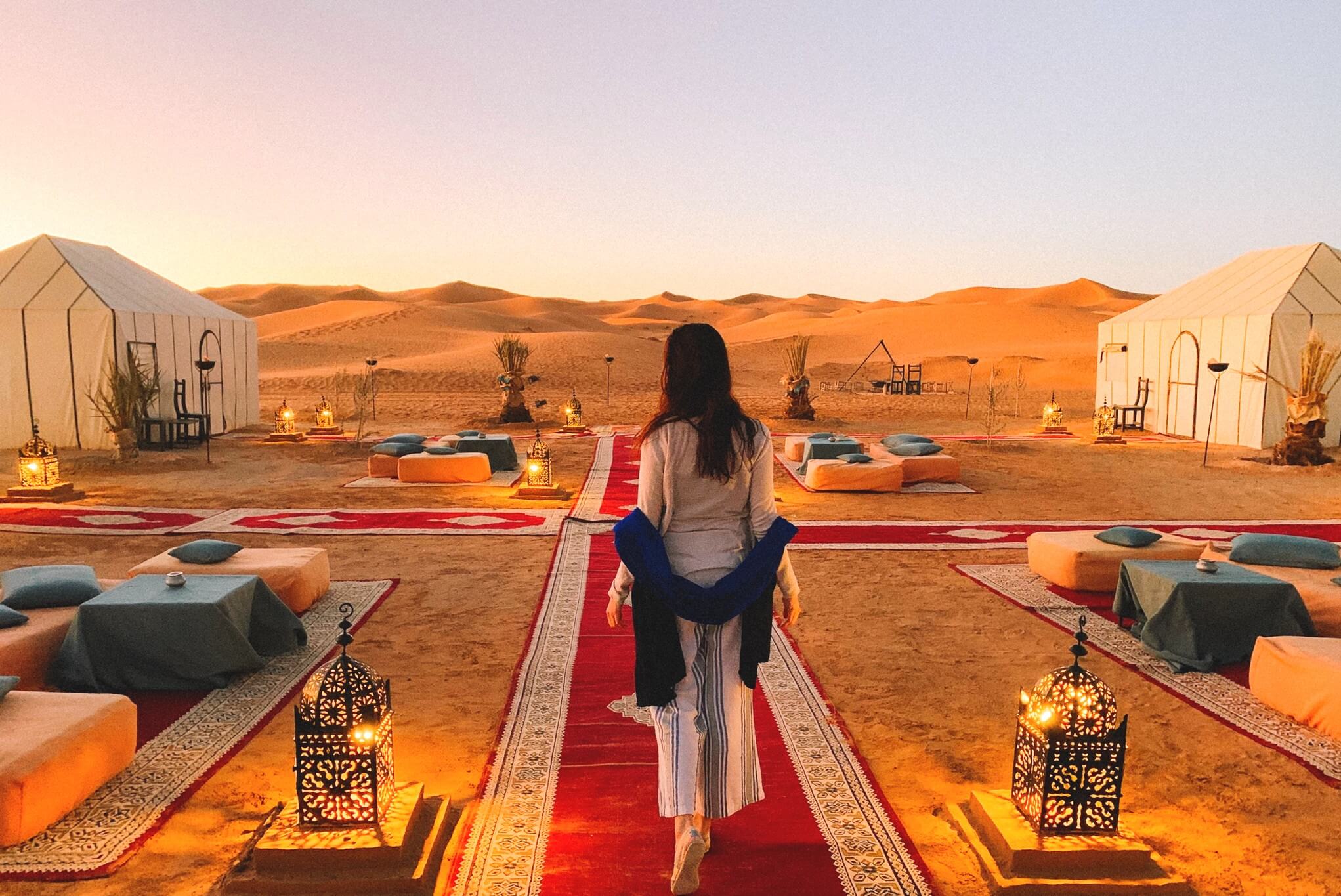
A camp of woollen canvas tents, planted in the heart of the Erg Chebbi dunes, often run by a nomadic or semi-nomadic family who have lived in the region for a long time.
No reception desk, no uniformed staff: the same people welcome you, serve dinner and host the evening.
This option appeals to travellers seeking an experience close to nomadic life, rather than a comfortable, polished version of the desert.
How does an evening at the camp unfold?
Camel departure from the guesthouse on the edge of the dunes, at sunset.
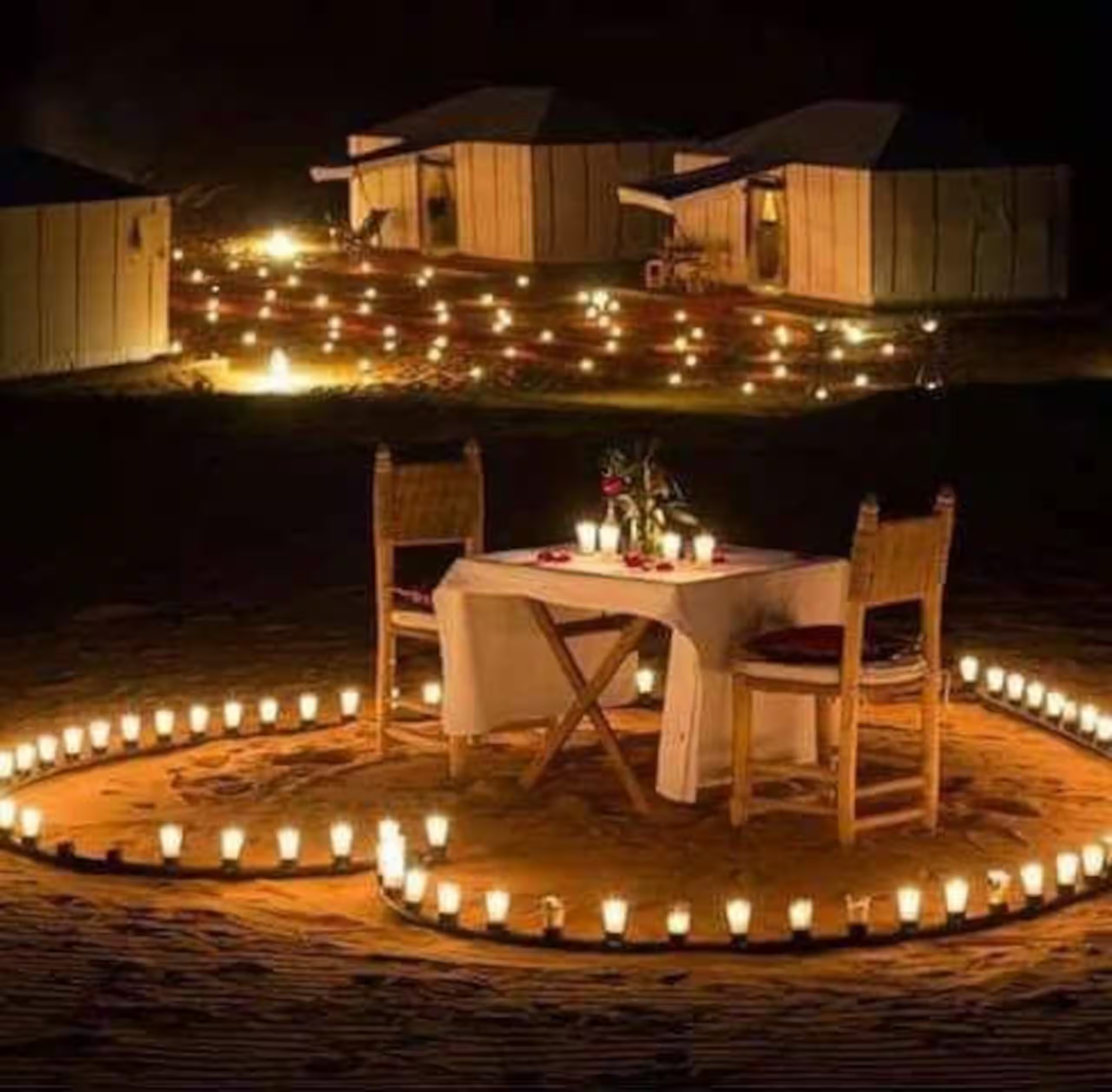
After about forty minutes of riding, the camp appears in a hollow between the dunes, lit by lanterns rather than electricity.
The traditional dinner — often a tagine, preceded by soup and followed by mint tea poured according to local ritual — is served under the communal tent.
The evening continues with a session of Berber drumming around the fire, a moment often improvised with the other travellers present.
Then the music stops.
Silence returns, and the Sahara sky, far from any artificial light, reveals the Milky Way in conditions rarely matched elsewhere.
What comfort can you really expect?
Contrary to popular belief, modern traditional desert camps are not rudimentary.
Comfortable mattresses, thick Berber wool blankets and pillows are provided in every tent.
The simplicity mainly concerns the bathrooms, shared between several tents, with no hot water or permanent electricity.
A detail that bothers some travellers and delights many others.
Our Standard Desert Camp, at 80 € per person (75 € for children), covers exactly this experience — transport, dinner, camel ride and breakfast included.
For more privacy, the luxury desert camp offers a private tent with bathroom, at 180 €.
Why do some travellers prefer the traditional over the luxury?
In a traditional desert camp, the music played in the evening is not a scheduled performance for tourists: it is often the same music played among families for generations, with the same instruments, the same rhythms passed down orally.
It is no coincidence that travellers who first tried a luxury camp then come back to try the traditional option — the extra comfort does not always replace that extra authenticity, as the Moroccan National Tourist Office notes in its presentation of Moroccan Saharan traditions.
A moment that stays, long after the return
What most travellers remember from a traditional desert camp is almost never the comfort of the tent.
It is more often a precise image: a camel handler's face lit by the fire telling a story, the first star appearing before the sun has even finished setting, the silence that settles once the music ends.
These details cannot be bought — but they come back, almost systematically, in the stories of those who chose this option over a more comfortable one.
Practical tip
Bring an extra warm layer even in peak season: traditional camp nights remain cool, and the thermal insulation of canvas tents is more basic than that of premium tents.
Book Your Merzouga Tour on WhatsApp
Instant confirmation with no deposit required in advance.
Pick-up from your hotel.
Book Your Stay